Block Quote
Airbnb, on the other hand, has been building something truly unique; the company explains in its S-1:
Travel is one of the world’s largest industries, and its approach has become commoditized. The travel industry has scaled by offering standardized accommodations in crowded hotel districts and frequently-visited landmarks and attractions. This one-size-fits-all approach has limited how much of the world a person can access, and as a result, guests are often left feeling like outsiders in the places they visit.
Airbnb has enabled home sharing at a global scale and created a new category of travel. Instead of traveling like tourists and feeling like outsiders, guests on Airbnb can stay in neighborhoods where people live, have authentic experiences, live like locals, and spend time with locals in approximately 100,000 cities around the world. In our early days, we described this new type of travel with the tagline “Travel like a human.” Today, people simply refer to it with a single word: “Airbnb.”
Image within Block Quote
The problem with the vast majority of antitrust complaints about big tech generally, and online services specifically, is that Page is right. You may only have one choice of cable company or phone service or any number of physical goods and real-world services, but on the Internet everything is just zero marginal bits.
That, though, means there is an abundance of data, and Google helps consumers manage that abundance better than anyone. This, in turn, leads Google’s suppliers to work to make Google better — what is SEO but a collective effort by basically the entire Internet to ensure that Google’s search engine is as good as possible? — which attracts more consumers, which drives suppliers to work even harder in a virtuous cycle. Meanwhile, Google is collecting information from all of those consumers, particularly what results they click on for which searches, to continuously hone its accuracy and relevance, making the product that much better, attracting that many more end users, in another virtuous cycle:
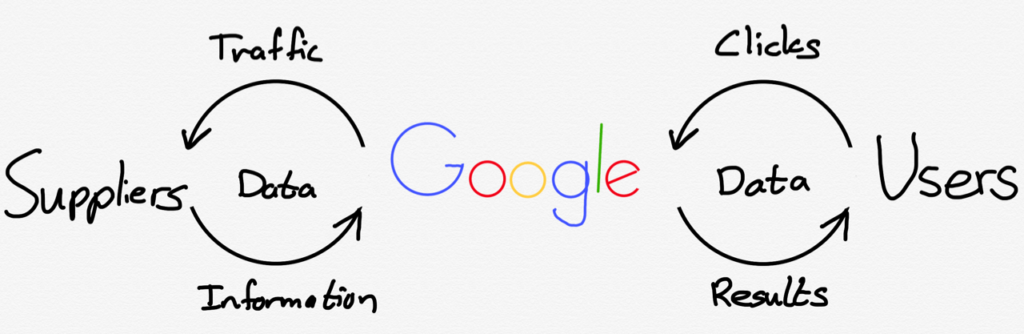
One of the central ongoing projects of this site has been to argue that this phenomenon, which I call Aggregation Theory, is endemic to digital markets. From the original Aggregation Theory Article:
The value chain for any given consumer market is divided into three parts: suppliers, distributors, and consumers/users. The best way to make outsize profits in any of these markets is to either gain a horizontal monopoly in one of the three parts or to integrate two of the parts such that you have a competitive advantage in delivering a vertical solution. In the pre-Internet era the latter depended on controlling distribution…Note how the distributors in all of these industries integrated backwards into supply: there have always been far more users/consumers than suppliers, which means that in a world where transactions are costly owning the supplier relationship provides significantly more leverage.
The fundamental disruption of the Internet has been to turn this dynamic on its head. First, the Internet has made distribution (of digital goods) free, neutralizing the advantage that pre-Internet distributors leveraged to integrate with suppliers. Secondly, the Internet has made transaction costs zero, making it viable for a distributor to integrate forward with end users/consumers at scale.
This has fundamentally changed the plane of competition: no longer do distributors compete based upon exclusive supplier relationships, with consumers/users an afterthought. Instead, suppliers can be commoditized leaving consumers/users as a first order priority. By extension, this means that the most important factor determining success is the user experience: the best distributors/aggregators/market-makers win by providing the best experience, which earns them the most consumers/users, which attracts the most suppliers, which enhances the user experience in a virtuous cycle.
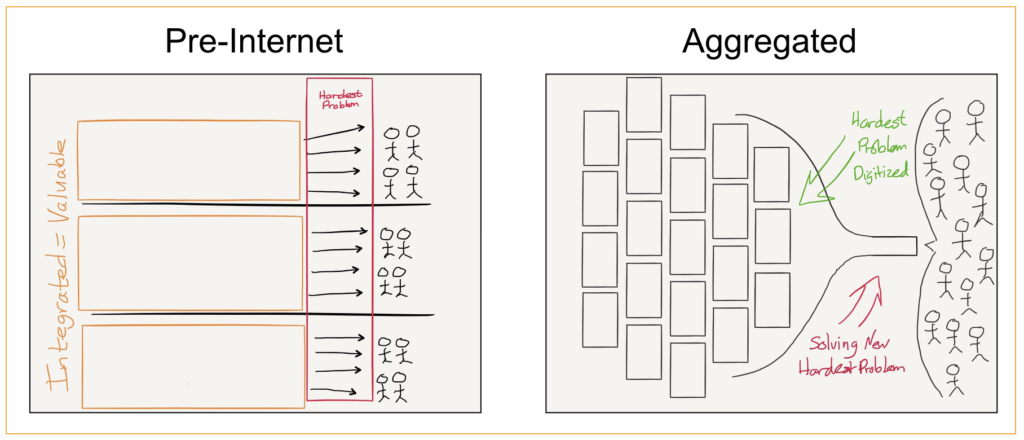
In short, increased digitization leads to increased centralization (the opposite of what many originally assumed about the Internet). It also provides a lot of consumer benefit — again, Aggregators win by building ever better products for consumers — which is why Aggregators are broadly popular in a way that traditional monopolists are not.
Unfortunately, too many antitrust-focused critiques of tech have missed this essential difference. I wrote about this mistake in Where Warren’s Wrong:
Perhaps it is best for Senator Warren’s argument that her article never does explain how these companies became so big, because the reason cuts at the core of her argument: Google, Facebook, Amazon, and Apple dominate because consumers like them. Each of them leveraged technology to solve unique user needs, acquired users, then leveraged those users to attract suppliers onto their platforms by choice, which attracted more users, creating a virtuous cycle that I have christened Aggregation Theory.
Aggregation Theory is the reason why all of these companies have escaped antitrust scrutiny to date in the U.S.: here antitrust law rests on the consumer welfare standard, and the entire reason why these companies succeed is because they deliver consumer benefit.
The European Union does have a different standard, rooted in a drive to preserve competition; given that the virtuous cycle described by Aggregation Theory does tend towards winner-take-all effects, it is not a surprise that Google in particular has faced multiple antitrust actions from the European Commission. Even the EU standard, though, struggles with the real consumer benefits delivered by Aggregators.
Consider the Google Shopping case: Google was found guilty of antitrust violations in a case brought by a shopping comparison site called Foundem, which complained about their site being buried when consumers were searching for items to buy. This complaint made no sense, as I explained in Ends, Means, and Antitrust:
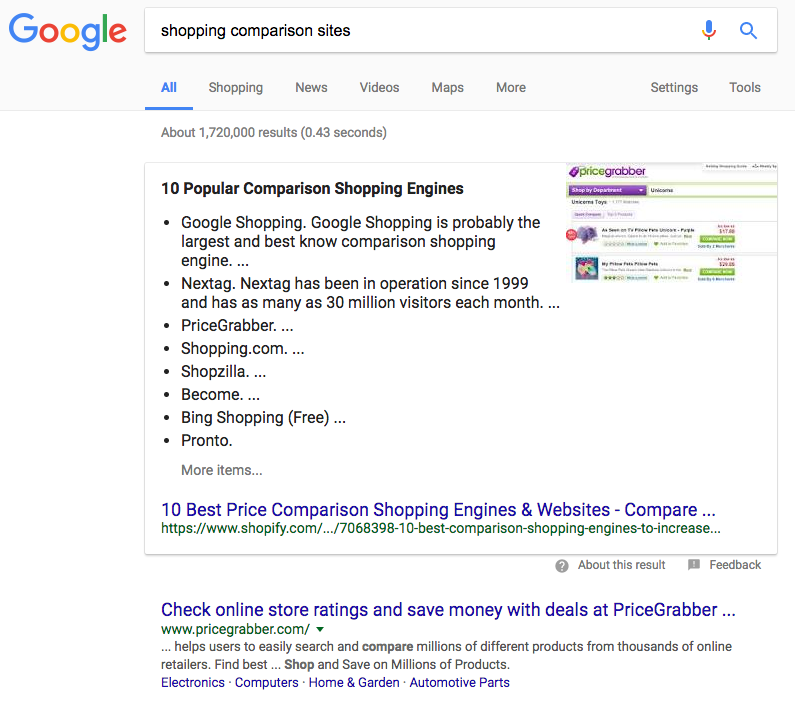
If I search for a specific product, why would I not want to be shown that specific product? It frankly seems bizarre to argue that I would prefer to see links to shopping comparison sites; if that is what I wanted I would search for “Shopping Comparison Sites”, a request that Google is more than happy to fulfill:
The European Commission is effectively arguing that Google is wrong by virtue of fulfilling my search request explicitly; apparently they should read my mind and serve up an answer (a shopping comparison site) that is in fact different from what I am requesting (a product)?
There is certainly an argument to be made that Google, not only in Shopping but also in verticals like local search, is choking off the websites on which Search relies by increasingly offering its own results. At the same time, there is absolutely nothing stopping customers from visiting those websites directly, or downloading their apps, bypassing Google completely. That consumers choose not to is not because Google is somehow restricting them — that is impossible! — but because they don’t want to. Is it really the purview of regulators to correct consumer choices willingly made?
Not only is that answer “no” for philosophical reasons, it should be “no” for pragmatic reasons, as the ongoing Google Shopping saga in Europe demonstrates. As I noted last December, the European Commission keeps changing its mind about remedies in that case, not because Google is being impertinent, but because seeking to undo an Aggregator by changing consumer preferences is like pushing on a string.
Block Quote within Block Quote
After the House Antitrust Committee released its report on the tech industry I wrote that it was important to distinguish between Anti-monopoly and Antitrust:
That, though, is why it is a mistake to read the report as some sort of technocratic document. There are, to be sure, a lot of interesting facts that were dug up by the committee, and some bad behavior, which may or may not be anticompetitive in the legal sense. Certainly the companies would prefer to have a legalistic antitrust debate, for good reason: it is exceptionally difficult to make the case that any of these companies are causing consumer harm, which is the de facto standard for antitrust in the United States. Indeed, what makes Google’s contention that “The competition is only a click away” so infuriating is the fact it is true.
What matters more is the context laid out by Letwin: there is a strain of political thought in America, independent of political party (although traditionally associated with Democrats), that is inherently allergic to concentrated power — monopoly in the populist sense, if not the legal one.
Hatred of monopoly is one of the oldest American political habits and like most profound traditions, it consisted of an essentially permanent idea expressed differently at different times. “Monopoly”, as the word was used in America, meant at first a special legal privilege granted by the state; later it came more often to mean exclusive control that a few persons achieved by their own efforts; but it always meant some sort of unjustified power, especially one that raised obstacles to equality of opportunity.
In other words, this subcommittee report is simply a new expression of an old idea; the details matter less than the fact it exists.
This is going to be a critical sentiment to keep in mind as this case unfolds. If I had to bet on an outcome, I would bet on Google winning. Apple and everyone else are free to enter into whatever contracts they wish, and consumers are free to undo the defaults that flow from those contracts. Where is the harm?
Images in Body and Block Quote
I wrote last month about the New York Times‘s traditional role in setting the national news agenda; headlines in the New York Times in the morning were lead stories on national newscasts in the evening, and headlines in regional papers the following day. If you map this dynamic to Moore’s model, it might look like this:
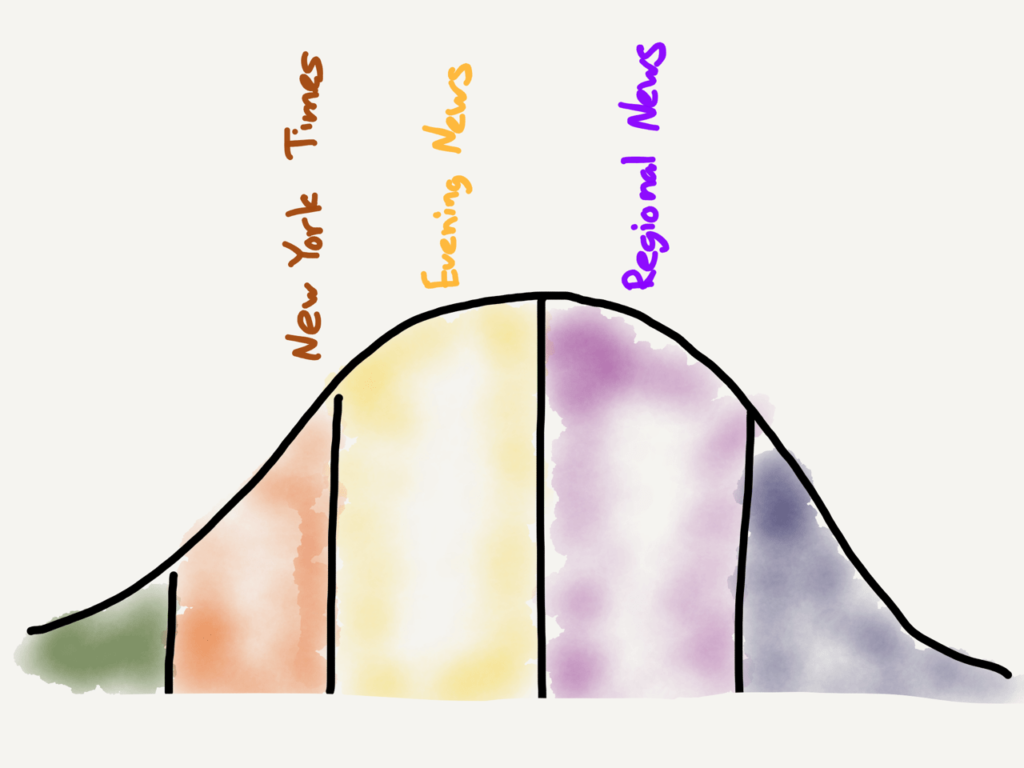
Where, though, did the New York Times get its ideas? Obviously a lot of stories came from its own reporting, or that of its peers, but the “enthusiast” part of the curve was mostly centered in academia. Visionaries, meanwhile, were a collection of think tanks, journals, and speciality magazines that operated at a loss, which was fine because making money was never the point: getting ideas into publications like the New York Times was.
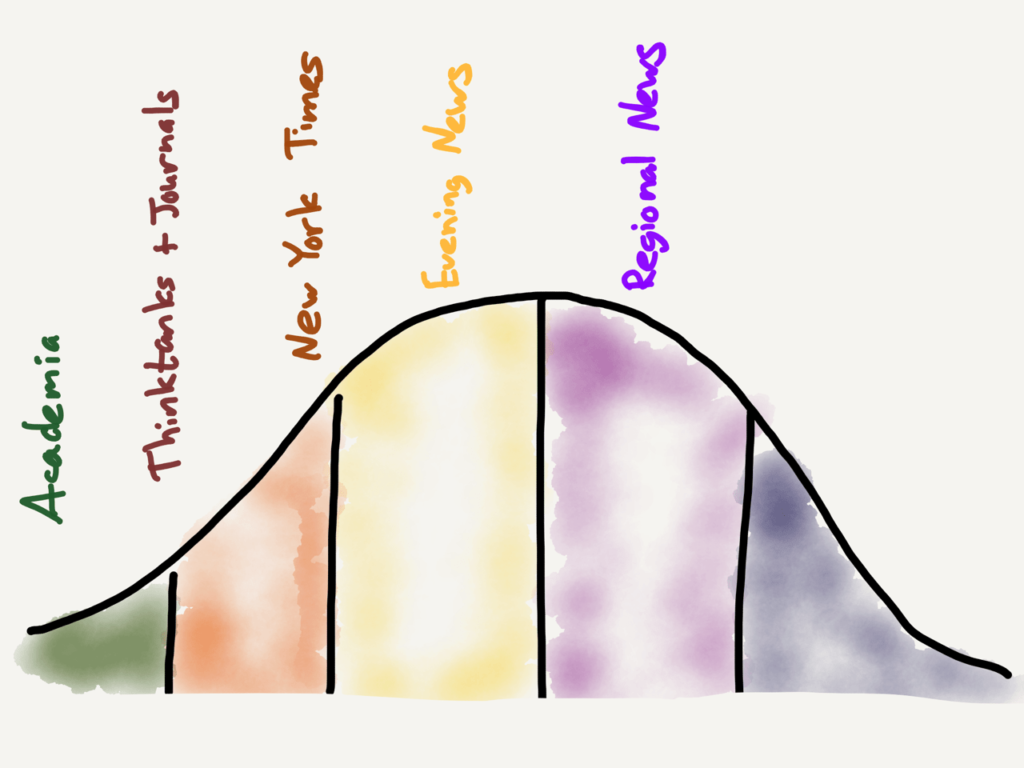
What happened in the 2000s, when Yglesias and Klein first burst on the scene as part of the original generation of political bloggers, was the development of a new genre of “enthusiasts” who were creating and debating new ideas mostly for free. Sure, most of these bloggers found work with publications like American Prospect (Yglesias) or Washington Monthly (Klein), but those publications were political projects, not economic ones, with the goal of influencing the mass market, not monetizing it.
Vox, on the other hand, has been something much different, both in terms of mission statement and business model. “Explaining the news” is, from a certain perspective, about crossing the chasm on the idea curve; enthusiasts have created new ideas, and visionaries have refined them, and now the challenge is to spread those ideas to the population generally. Vox’s business model, meanwhile, is firmly on the right hand side of the curve. Advertising is all about scale, and the vast majority of the market falls to the right of the chasm.
The problem with this approach, though, is that publications simply aren’t as good at advertising as Facebook and Google. I wrote five years ago in Popping the Publishing Bubble:
Publishers and ad networks are locked in a dysfunctional relationship that doesn’t serve readers or advertisers, and it’s only a matter of time until advertisers — which again, care only about reaching potential customers, wherever they may be — desert the whole mess entirely for new, more efficient and effective advertising options that put them directly in front of the people they care about. That, first and foremost, is Facebook, but other social networks like Twitter, Snapchat, Instagram, Pinterest, and others will benefit as well:
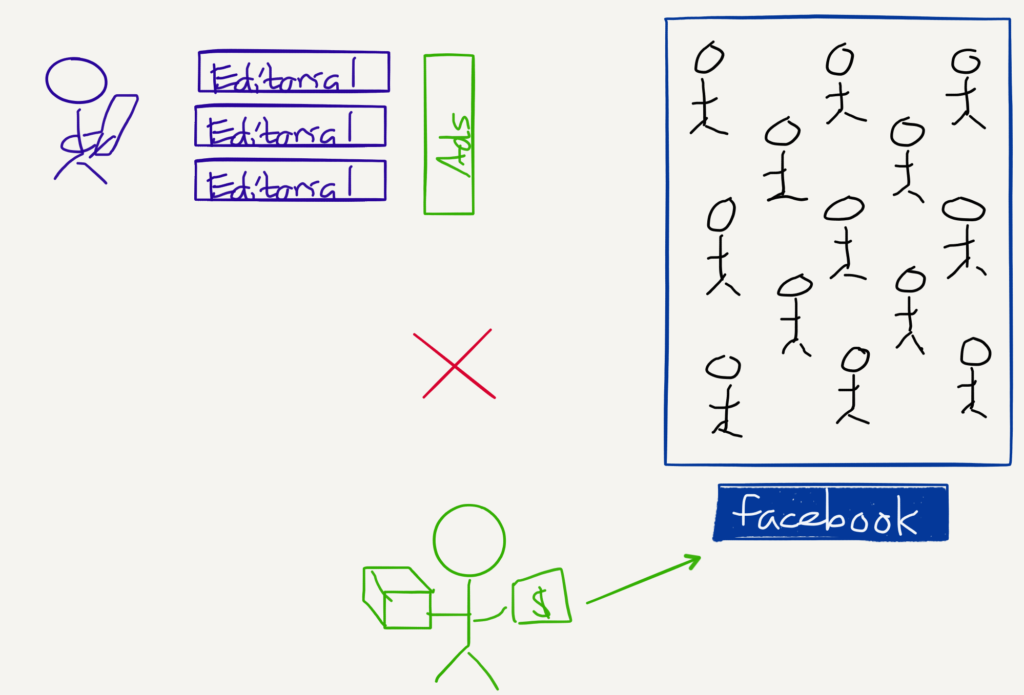
I don’t know the specifics of how Vox’s business is doing, although it is notable that the site’s previous ad inventory is now mostly filled with requests for donations; meanwhile, there is no confusion about the business models of either Substack or the New York Times.
VideoPress Test (Both in Body and Block Quote)
The single most compelling line of questioning came from Louisiana junior Senator John Kennedy;1 first, he exposed the company’s implied claims that they could actually fix the problem as a sham:
This is the exact issue I discussed in The Super Aggregators and the Russians:
Super-aggregators not only have zero transaction costs when it comes to users and content, but also when it comes to making money. This is at the very core of why Google and Facebook are so much more powerful than any of the other purely information-centric networks. The vast majority of advertisers on both networks never deal with a human (and if they do, it’s in customer support functionality, not sales and account management): they simply use the self-serve ad products like the one pictured above (or a more comprehensive tool built on the companies’ self-serve API).
I added up the numbers in Trustworthy Networking, estimating that Facebook served 276 million unique ads per quarter, and my entire point was the same as Kennedy’s: there is no way that Facebook could ever review every ad, much less investigate who is behind them, without completely ruining their revenue model.
Kennedy wasn’t done, though: he went on to press Stretch in particular about just how much data Facebook has about, well, everyone:
Stretch was insistent that Facebook would never look up the data on any one individual, both because of internal policies as well as the way the company’s data store was engineered. What Kennedy was driving at, though, is that Facebook could; here is the transcription:
Lina Khan, who rose to prominence with her 2017 law review article Amazon’s Antitrust Paradox, and who served as counsel for the antitrust subcommittee over the course of the investigation that culminated in Wednesday’s hearings, summarized the New Brandeis Movement of antitrust in 2018:
As the name suggests, this new movement traces its intellectual roots to Justice Louis Brandeis, who served on the Supreme Court between 1916 and 1939. Brandeis was a strong proponent of America’s Madisonian traditions—which aim at a democratic distribution of power and opportunity in the political economy. Early in the twentieth century, Brandeis successfully updated America’s antimonopoly regime, along Madisonian lines, for the industrial era, and his philosophy held sway well into the 1970s. As the ‘New Brandeis School’ gains prominence — even prompting two floor speeches by Senator Orrin Hatch (a Republican from Utah) — it’s worth understanding what this vision of antimonopoly does and does not represent.
While the article is worth reading in full, it is no accident that Khan started with “democracy”:
Brandeis and many of his contemporaries feared that concentration of economic power aids the concentration of political power, and that such private power can itself undermine and overwhelm public government. Dominant corporations wield outsized influence over political processes and outcomes, be it through lobbying, financing elections, staffing government, funding research, or establishing systemic importance that they can leverage. They use these strategies to win favorable policies, further entrenching their dominance.
Brandeis also believed that the structure of our markets and of our economy can determine how much real liberty individuals experiences in their daily lives. Most people’s day-to-day experience of power comes not from interacting with public officials, but through relationships in their economic lives — negotiating pay with an employer, for example, or wrangling the terms of business with a trading partner. Brandeis feared that autocratic structures in the commercial sphere — such as when one or a few private corporations call all the shots — can preclude the experience of liberty, threatening democracy in our civic sphere.
Chairman David Cicilline, in the conclusion to his opening statement, made a clear gesture to the New Brandeis Movement:2
Because concentrated economic power also leads to concentrated political power, this investigation also goes to the heart of whether we as a people govern ourselves, or whether we let ourselves be governed by private monopolies. American democracy has always been at war against monopoly power. Throughout our history, we’ve recognized that concentrated markets and concentrated political control are incompatible with democratic ideals. When the American people confronted monopolies in the past, be it the railroads or the oil tycoons or AT&T and Microsoft, we took action to ensure no private corporation controls our economy or our democracy.
What was notable to me is that in the hearing Cicilline and the other Democrats never really focused on this point; the rest of Cicilline’s opening statement, and much of the Democratic questioning, focused on what they perceived as illegal activities that caused economic harm, without necessarily tying that to political harm. Again, that’s not to say they were ignoring the linkage, but it wasn’t a priority.
What made this stand out was that Republicans were focused almost entirely on the politics of monopoly, specifically their contention that large platforms, particularly Google and Facebook (and Twitter), were censoring conservative viewpoints and working to elect Democratic candidates to office, particularly the presidency, and that this was a problem because of their dominance. Leave aside, if you can, your opinion about the veracity of these complaints (and remember my note at the beginning about focusing on analysis): while the Republicans were certainly not endorsing the “New Brandeis School” — Ranking Member James Sensenbrenner in particular took care to highlight support for the consumer welfare standard, also known as the “Chicago School” — their concern with the size of tech companies had nothing to do with economic effects and everything to do with political effects. It was a striking contrast.
Table Test (In body, in block quote)
I am tempted to claim vindication, but the truth is that we very well may see a 12S next year; note the pattern for top-of-the-line models:
| Industrial Design | Cameras | |
|---|---|---|
| iPhone | New | 1 |
| iPhone 3G | New | 1 |
| iPhone 3GS | Old | 1 |
| iPhone 4 | New | 1 |
| iPhone 4S | Old | 1 |
| iPhone 5 | New | 1 |
| iPhone 5S | Old | 1 |
| iPhone 6 | New | 1 |
| iPhone 6S | Old | 1 |
| iPhone 7 | Old | 2 |
| iPhone X | New | 2 |
| iPhone XS | Old | 2 |
| iPhone 11 Pro | Old | 3 |
| iPhone 12 Pro | New | 3 |
With the iPhone 7 Apple kept the same industrial design for a third generation, but added a second camera; the company did the same thing last year with the iPhone 11, but in this case added a third camera. If the pattern holds, next year will be a quiet one on the industrial design and camera front — an ‘S’ year, in other words.
Of course Apple’s line has also expanded over the last four years to include a lower-cost model (that is actually the price that flagship iPhones used to be):
| Industrial Design | Cameras | |
|---|---|---|
| iPhone 8 | Old | 1 |
| iPhone XR | New | 1 |
| iPhone 11 | Old | 2 |
| iPhone 12 | New | 2 |
If this patterns holds the iPhone 12S will keep the current design as well as the 12S Pro, but perhaps add a third camera.
iPhone Pricing
This is the bit that is more interesting; from Gruber:
Here’s a matrix with the new lineup, organized the way I think makes the most sense. In the bottom row, I compare all storage tiers to 128 GB as a baseline. Storage is priced very consistently this year: across all iPhone models, every 64 GB of additional storage costs $50.
64 GB 128 GB 256 GB 512 GB iPhone 12 Pro Max — $1,100 $1,200 $1,400 iPhone 12 Pro — 1,000 1,100 1,300 iPhone 12 830 880 980 — iPhone 12 Mini 730 780 880 — iPhone 11 600 650 750 — iPhone XR 500 550 — — iPhone SE 400 450 550 — Δ from 128 GB -50 — +100 +300 I think it’s useful to include last year’s prices for the then-new iPhone 11 lineup for comparison:
64 GB 128 GB 256 GB 512 GB (2019) 11 Pro Max $1,100 — $1,250 $1,450 (2019) 11 Pro 1,000 — 1,150 1,350 (2019) iPhone 11 700 750 850 — Zeroth, all prices I’ve listed are for unlocked phones. Apple’s promotion of the iPhone 12 and 12 Mini as starting (respectively) at $799/699 rather than $829/729 just because of some sort of marketing deals they cut with AT&T and Verizon for existing AT&T and Verizon customers is $30 worth of bullshit. (And now Apple has let T-Mobile join the club.)
Footnote Test (normal and block quote within footnote)
To put it another way, I was too focused on demand — the key to Aggregation Theory — and didn’t think deeply enough about the evolution of supply. User-generated content didn’t have to be simply picture of pets and political rants from people in one’s network; it could be the foundation of a new kind of network, where the payoff from Metcalfe’s Law is not the number of connections available to any one node, but rather the number of inputs into a customized feed.3
Moreover, a lot of commentary felt stuck in 2012: Facebook forever competing against MySpace (but Instagram being a bargain was totally predictable!), Amazon against no one (Shopify was mentioned once), Google versus ten blue links, and Apple, well, they are in good shape: despite having arguably the most egregious practices under traditional antitrust law, the iPhone maker was the only company in the Executive Summary to be praised for its impact on society.4 In the committee’s telling, these companies are bad actors that do bad things, case closed.
Twitter Test (in body, in block quote, with video)
On November 2, 2016, Microsoft announced Teams at a special event in New York City. Slack decided to mark the occasion:
That feeling when you think “we should buy a full page in the Times and publish an open letter,” and then you do. 💫 pic.twitter.com/BQiEawRA6d
— Stewart Butterfield (@stewart) November 2, 2016
Last night’s Academy Awards ceremony provided drama that was itself worthy of an award:
WATCH: ‘La La Land’ announced as #Oscars Best Picture winner, but only until a mistake is realized with ‘Moonlight’ being the real winner. pic.twitter.com/wYsUngcdwe
— ABC News (@ABC) February 27, 2017
I opened The Super-Aggregators and the Russians with this anecdote:
In August 2011, just a day or two into my career at Microsoft, I sat in on a monthly review meeting for Hotmail (now known as Outlook.com); the product manager running the meeting was going through the various geographies and their relevant metrics — new users, churn, revenue, etc. — and it was, well, pretty boring. It was only later that I realized just how astounding “boring” was; a small group of people in a conference room going over numbers that represented hundreds of millions of people and dollars in revenue, and most of us cared far more about what was on the menu for lunch.
I’ve reflected on that meeting often over the years, particularly when it comes to Facebook and controversies like censoring too much, censoring too little, or “fake news”, and I was reminded of it again with this tweet:
And they paid in RUBLES. Seriously. https://t.co/D35tvhUEcj
— Mark Warner (@MarkWarner) September 14, 2017
Mark Warner, the senior Senator from Virginia, is referring to a Russian company, thought to be linked to the Kremlin’s propaganda efforts, having bought $100,000 worth of political ads on Facebook, some number of which directly mentioned 2016 presidential candidates Donald Trump and Hillary Clinton. Facebook has released limited details about the ads, likely due to its 2012 consent decree with the FTC, which bars the company from unilaterally making private information public, as well as the problematic precedent of releasing information without a clear order compelling said release. To that end, it was reported over the weekend that special counsel Robert Mueller received a much more comprehensive set of data from Facebook after obtaining a search warrant.
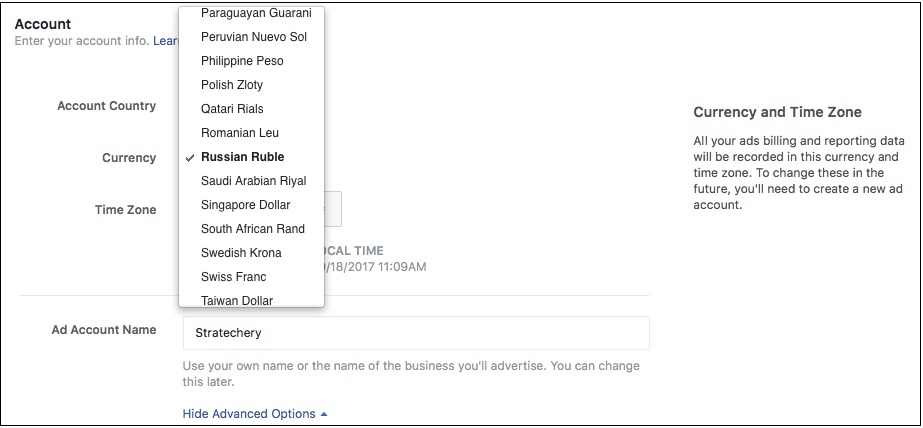
Even with all that context, though, I found Senator Warner’s tweet puzzling: how else would the propaganda group have paid? Facebook’s self-service ad portal lets you buy ads in 55 different currencies, including the Russian Ruble:5
That, though, brought me back to that Hotmail meeting: that I, and probably many more in the tech industry, find the idea of Facebook selling ads in rubles to strangers to be utterly unremarkable, even as thousands find it equally outrageous and damning, is a reminder of just how unprecedented and misunderstood aggregators like Facebook continue to be, and what a challenge it will be to regulate them.
IG Test
However, the first lesson from Dave Chappelle’s latest release on Instagram, Unforgiven, is that one best not compete with Chappelle when it comes to story-telling; the way in which the comedian weaves together multiple stories from his childhood on up to the present to make his argument about why he should be paid for the rights to stream Chappelle’s Show is truly extraordinary.
View this post on Instagram
Overall Embed Test (Social)
View this post on Instagram
No relation to the Massachusetts political family ↩
That is Khan sitting behind Cicilline ↩
This, by the way, is actually a much more accurate manifestation of Metcalfe’s Law, which is about potential contacts in a network, not actual contacts; a long-standing criticism of using Metcalfe’s Law to describe social networks is that the attractiveness of most social networks is a function of how many people you know that are on the network, not how many you might know. That is why, for example, LINE is a much more valuable chat app for me in Taiwan than is WeChat, even though WeChat has vastly more users; more people I know are on LINE. TikTok, though, surfaces content from anyone, which is to say its value hews much more closely to Metcalfe’s Law. ↩
From the report:
Apple’s mobile ecosystem has produced significant benefits to app developers and consumers. Launched in 2008, the App Store revolutionized software distribution on mobile devices, reducing barriers to entry for app developers and increasing the choices available to consumers.
Again, there is not a single positive word about the other three companies in the executive summary. ↩
For what it’s worth, Stratechery has never actually taken out a Facebook ad, or any ad for that matter ↩